Beliefs
Downward arrow: find the belief under a thought
The downward arrow follows a thought down to the belief underneath it. You ask, again and again, “If that were true, what would it mean?” until you reach what the thought says about you at its core. It's useful when the same kind of thought keeps coming back.
At a glance
| Time | 5 min |
|---|---|
| Best for | Being hard on myself and Feeling low or flat |
| Level | Deeper. Goes deeper, into beliefs; easier after some practice with thought work. |
| You rate | How much you believe the core belief, from 0 to 100% |
How to do it, step by step
- Choose a thoughtOne that comes back in different situations.
- Ask what it would mean“If that were true, what would it mean?” Write the answer.
- Ask againRepeat with each new answer, two to four times.
- Name the coreWhat does it say about you, at its core? Often a short sentence, like “I'm not good enough.”
- Rate how much you believe itThen take it into a core belief log or a continuum.
Downward arrow example: an unanswered email
- Thought
- “My boss hasn't replied to my email.”
- If true, it means
- “She's unhappy with my work.”
- And that means
- “I'll be let go.”
- And that means
- “I'm not good at anything.”
- At its core
- “I'm a failure.” Believe it 60%.
Example only. The numbers are illustrative, not typical results.
Tips and common snags
Go gently
Core beliefs can feel heavy. Stop when you've found it; you don't need to argue with it yet.
It's a belief, not a fact
Finding it is a first step towards checking it.
Next steps
A core belief log or a continuum helps you build a fairer view.
In ThinkGO
Downward arrow, one question at a time
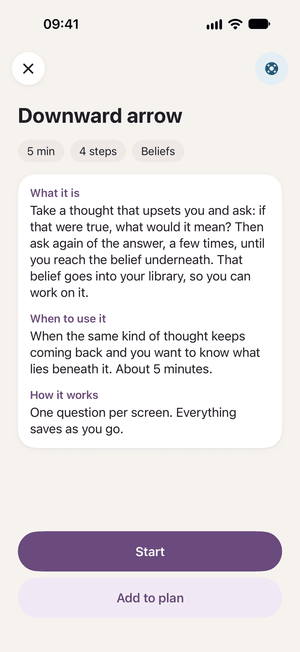
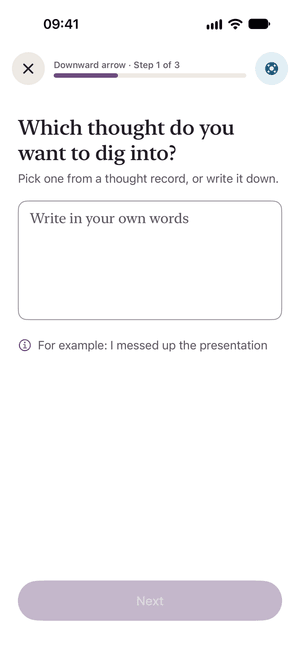
- One question per screen
- Drafts saved on every change
- Your before and after ratings, side by side
- Reminders, if you want them
Coming to the App Store in January 2027
Sources
- Burns, D. D. (1980). Feeling Good: The New Mood Therapy. William Morrow.
- Beck, J. S. (2020). Cognitive Behavior Therapy: Basics and Beyond (3rd ed.). Guilford Press.