Beliefs
Core belief log: collect evidence for a fairer view of yourself
A core belief log helps a fairer belief about yourself grow over a few weeks. You name the old belief and a fairer one, then once a day note something that happened which supports the new one. It takes about a minute a day.
At a glance
| Time | 1–5 min |
|---|---|
| Best for | Being hard on myself and Feeling low or flat |
| Level | Deeper. Goes deeper, into beliefs; easier after some practice with thought work. |
| You rate | How much you believe the old belief and the new one, from 0 to 100% |
How to do it, step by step
- Name the old beliefFor example “I'm unlikeable.” Rate how much you believe it.
- Write a fairer beliefNot the opposite, just fairer: “Some people like me, and I'm likeable enough.” Rate it.
- Log evidence dailyEach day, one small thing that supports the new belief.
- Review after a few weeksRate both beliefs again and read back through the log.
Core belief log example: three weeks
- Old belief
- “I'm unlikeable.” Believe it 70%.
- Fairer belief
- “Some people like me, and I'm likeable enough.” Believe it 20%.
- Monday
- A colleague saved me a seat at lunch.
- Wednesday
- My sister called just to chat.
- Friday
- A neighbour thanked me for taking in a parcel.
- After three weeks
- Old belief 45%, fairer belief 50%
Example only. The numbers are illustrative, not typical results.
Tips and common snags
Small evidence counts
A smile, a reply, a thank-you.
Write it the same day
Small things fade by tomorrow.
Expect slow change
Beliefs built over years shift over weeks, not days.
In ThinkGO
Core belief log, one question at a time
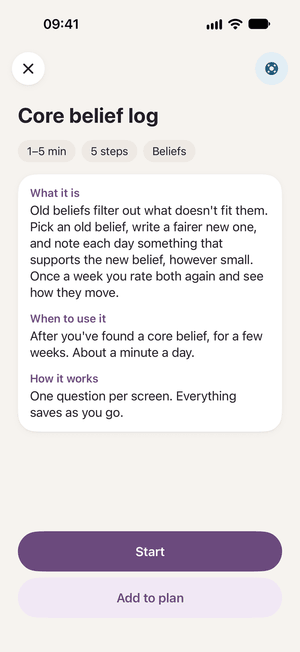

- One question per screen
- Drafts saved on every change
- Your before and after ratings, side by side
- Reminders, if you want them
Coming to the App Store in January 2027
Sources
- Padesky, C. A. (1994). Schema change processes in cognitive therapy. Clinical Psychology & Psychotherapy, 1(5), 267–278.
- Beck, J. S. (2020). Cognitive Behavior Therapy: Basics and Beyond (3rd ed.). Guilford Press.
- Greenberger, D., & Padesky, C. A. (2016). Mind Over Mood (2nd ed.). Guilford Press.