For therapists and their clients
A private place for CBT homework between sessions
Clients practise thought records, behavioural activation, exposure ladders and worry time on their iPhone, then bring a PDF of their entries to the session.
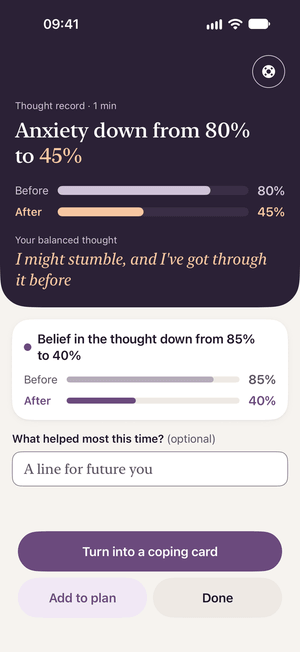
What clients can practise
All 20 exercises, in the groups the app uses. Each one asks one question per screen and saves a draft as the client goes.
Thought work
Thought record, ABC record, Socratic questions, Double-standard
Activities
Activity monitoring, Activity scheduling, Behavioural experiment
Exposure
Fear ladder, Exposure practice
Beliefs
Downward arrow, Core belief log, Continuum, Responsibility pie
Worry and problems
Worry time, Problem solving, Cost-benefit
Daily
Coping cards, Daily mood check-in
Calm
Paced breathing, 5-4-3-2-1 grounding
How the PDF export works
- The client chooses what goes inA date range or single entries, which exercises, and whether to add the mood and check-in charts.
- Adds a password, if they wantThe file can be locked before it leaves the iPhone. A name on the cover is optional.
- Shares it their wayEmail, AirDrop, print or Files, from the iPhone share sheet. Nothing is shared automatically.
- Thought record
- 12 October. Asked to present at the team meeting.
- Before → after
- Anxious 80% → 45%. Embarrassed 40% → 20%.
- Fairer thought
- One meeting doesn't decide my career.
Made-up example. A real export shows the client's own entries and their own before and after ratings.
What you receive
A PDF file. No account, no app and no dashboard for you, and nothing is sent to us.
Privacy
Entries stay on the client's iPhone and in their own iCloud. No account, no ads, no ad trackers.
Not a clinical tool
ThinkGO is a self-help tool based on CBT techniques for use between sessions. It doesn't replace a therapist, a doctor or a diagnosis.