Thought work
Sleep thoughts check: look calmly at one worry about sleep
Lying awake, it is easy to think the worst about sleep and about tomorrow, and those thoughts can make it harder to settle. The sleep thoughts check is a short thought record for one of them: write it down, notice the thinking trap, list what you actually know about nights like this, and find a calmer way to put it. It is part of the sleep worries program in ThinkGO.
At a glance
| Time | 3–5 min |
|---|---|
| Best for | Worries at bedtime |
| Level | Starter. A good first exercise. |
How to do it, step by step
- Write the thought about sleepThe way it sounds in your head.
- Name the feeling and rate the beliefWhat you feel, and how much you believe the thought from 0 to 100%.
- Look for thinking trapsCatastrophising and fortune-telling are common at night.
- List what you know about nights like thisOther short nights, and how the next day really went.
- Write a calmer versionFair and believable, not just positive.
- Rate againHow much you believe each thought now, and how strong the feelings are.
Sleep thoughts example: a short night before a meeting
- Thought
- “If I don't fall asleep soon, tomorrow will be a disaster.” (80%)
- Feeling
- Anxious
- Thinking traps
- Catastrophising, fortune-telling
- What I know
- Last week I slept five hours and still got through the meeting.
- Calmer version
- “A short night is unpleasant, not a disaster. I've managed tired days before.” (60%)
- First thought now
- 40%
Example only. The numbers are illustrative, not typical results.
Tips and common snags
Do it once, then rest
One thought checked is enough for tonight.
Daytime works too
You can check a thought you had last night the next afternoon.
If sleep stays poor
If poor sleep goes on for weeks, talk to your doctor.
In ThinkGO
Sleep thoughts check, one question at a time
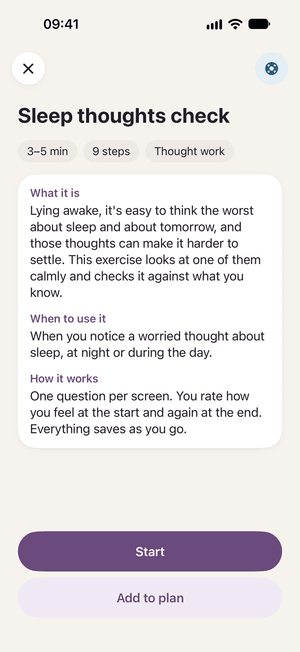
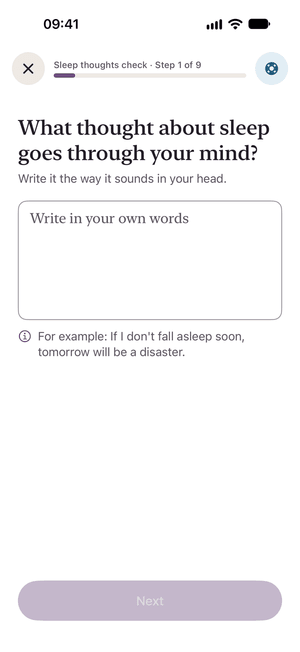
- One question per screen
- Drafts saved on every change
- Your before and after ratings, side by side
- Reminders, if you want them
Coming to the App Store in January 2027
Sources
- Harvey, A. G. (2002). A cognitive model of insomnia. Behaviour Research and Therapy, 40(8), 869–893.
- Greenberger, D., & Padesky, C. A. (2016). Mind Over Mood (2nd ed.). Guilford Press.
- Insomnia. NHS.
- Reframing unhelpful thoughts. Every Mind Matters, NHS.